


Coaching at work is a non-directive form of development: it focuses on improving someone’s performance and developing them, mostly by asking rather than telling. Mentoring is a relationship in which a more experienced colleague shares what they know to support someone less experienced (CIPD).
In short: a mentor shares their experience; a coach helps you find your own answers.
MindsetOS started from the view that the coaching that develops mindset should not be reserved for a handful of executives. It gives everyone in an organisation an AI-powered mindset coach.
| Coaching | Mentoring | |
|---|---|---|
| What it is | A non-directive form of development, focused on improving performance and developing the individual. | A relationship in which a more experienced colleague shares their knowledge to support someone less experienced. |
| Who does it | Members of staff or external coaches. In the UK, line managers are the most likely to take the main responsibility for coaching. | A more experienced colleague. |
| The skills | Questioning, listening, clarifying and reframing. | The same skills as coaching, alongside sharing knowledge. |
MindsetOS is a mindset development platform for whole organisations. Everyone gets their own map and a coach for the moments that matter, and leaders get anonymised team mindset maps.
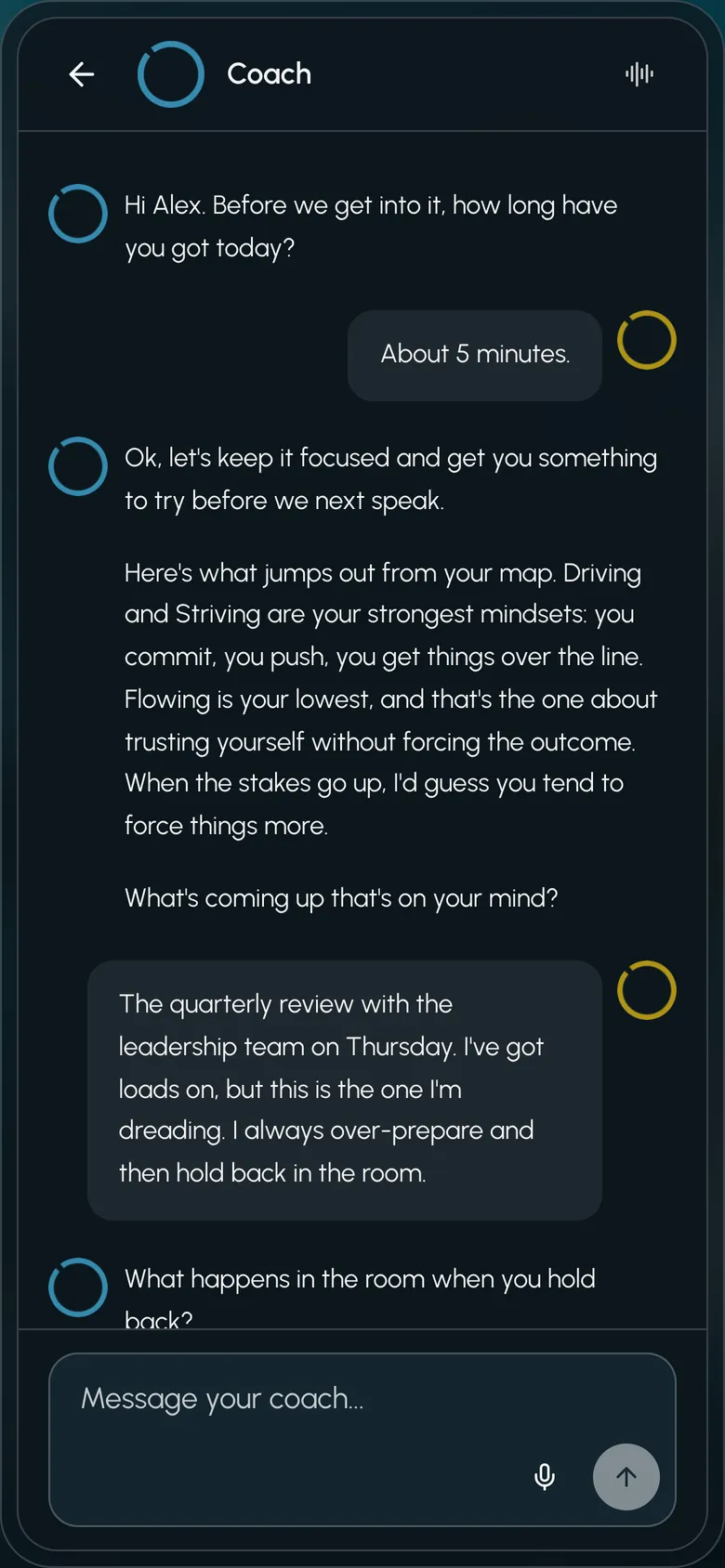

Coaching is a non-directive form of development, focused on improving performance and developing the individual. Mentoring is a relationship in which a more experienced colleague shares their knowledge to support someone less experienced (CIPD). A mentor shares their experience; a coach helps you find your own answers.
Coaching in the workplace helps people improve their performance and develop, mostly through questions rather than instructions. It can come from line managers, internal coaches, external coaches or, with MindsetOS, an AI-powered mindset coach available to everyone in the organisation.
In the UK, line managers are the most likely to take the main responsibility for coaching at work (CIPD). See coaching for managers.
Yes. Mentoring calls on the questioning, listening, clarifying and reframing skills associated with coaching (CIPD).
The MindsetOS coach is a coach. It doesn’t hand you answers: good coaching should sometimes challenge your thinking, ask the awkward question and help you see what you might be missing. It’s human designed and AI-powered, and every conversation is underpinned by your mindset map.